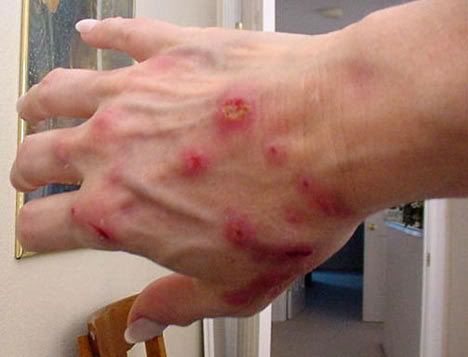
Federal Study Of Morgellons yields No Answers.ATLANTA - Imagine having the feeling of tiny insects crawling on your body, you have oozing sores and mysterious fibers sprouting from your skin. Sound like a horror movie? Well, at one point several years ago, doctors were getting the government up to 20 calls a day from people saying they had such symptoms.
Many of these people were in California and one of the senators of the U.S. state, Dianne Feinstein, has asked a scientific study. In 2008, federal health authorities began to study people say they have been affected by this strange condition called Morgellons.
The study cost about $ 600,000. His highly anticipated results, released Wednesday, concluded that Morgellons exists only in the minds of patients.
"We found no infectious cause," said Mark Eberhard, a Center for Disease Control and Prevention official who was part of the study team of 15 members.
The study is published in PLoS One, a Public Library of scientific journals.
Morgellons sufferers describe a variety of symptoms, including fatigue, sores erupting, crawling sensations on their skin and - perhaps worst of all - mysterious red, blue or black fibers that sprout from their skin. Some say they have suffered for decades, but the syndrome was not appointed until 2002, when "Morgellons" was chosen from a 1674 medical paper describing similar symptoms.
Patients afflicted have documented their suffering on Web sites, and many have sought in vain a doctor who believed them. Some doctors believe the condition is a form of delusional parasitosis, a psychosis in which people believe they are infected with parasites.
Last May, Mayo Clinic researchers published a study of 108 patients Morgellons and none of them is suffering from a physical unusual. The study concluded that the wounds of many of them were caused by their own scratching and picking at their skin.
The CDC study was designed to be wider, starting with a large population and then search for cases within the group. The intention was to give scientists a better idea of how common Morgellons is.
They covered more than 3 million people living in 13 counties in Northern California, a location chosen in part because all had health insurance through Kaiser Permanente Northern California, which had a branch of research that could help the project. In addition, many anecdotal reports of Morgellons from the region.
Culling through Kaiser patient records from July 2006 to June 2008, the team found - and was able to achieve - 115 who had what looked like Morgellons. Most were middle-aged white women. They have not been consolidated in one place.
This led to the finding that Morgellons occurred in about 4 of every 100,000 people registered Kaiser. "So it's rare," said Eberhard.
About 100 at least agree to respond to the survey questions, and about 40 consented to a battery of physical and psychological tests which extended over several days.
Blood tests and urine tests and skin biopsies tested for dozens of infectious diseases, including fungi and bacteria that could cause some symptoms. Researchers have found none that could explain the case.
There was no evidence of an environmental cause, either, although researchers do not go to the home of each person to look around.
They took fibers from 12 people who were tested at the Institute of Pathology Armed Forces. Nothing unusual there either. Cotton and nylon, mainly - not some kind of body wriggling out of the body of a patient.
The skin lesions were common, but the researchers concluded most of them from scratching.
What stands out is how patients have on psychological tests. Although normal in most respects, they had more depression than the general population and are more obsessive about physical ailments, the study found.
However, they did not have an unusual history of psychiatric problems, according to their medical records. And tests gave no clear indication of a delusional disorder.
So what do they have? Researchers do not know. They do not even know what to call it, opting for the label "unexplained dermopathy" in their papers.
But clearly, something the poor. "The absence of evidence is not evidence of absence," said Felicia Goldstein, an Emory University neurology professor and study co-author.
She said maybe patients could be helped by cognitive behavior therapy that could help deal with possible contributing psychological problems.
The study should not be the last word on the subject.
Among those who have additional questions was Randy Wymore, an Oklahoma State University pharmacologist who was for years the leading scientists to look at it and concluded that Morgellons is not a psychiatric disorder.
Wednesday, Wymore said he had not seen the paper and CDC was unable to comment. But when the study began, he wondered whether patients with Morgellons Kaiser participate, especially if they were dissatisfied with the way they were previously managed by Kaiser Physicians.
"There's always the question: How many participants in the study were the Morgellons?" He said in an email.
The CDC does not provide for further study, however. The agency's expertise is in infectious diseases and environmental health problems, and researchers have seen no evidence of that.
"We are not mental health experts," a CDC spokesman.
Many of these people were in California and one of the senators of the U.S. state, Dianne Feinstein, has asked a scientific study. In 2008, federal health authorities began to study people say they have been affected by this strange condition called Morgellons.
The study cost about $ 600,000. His highly anticipated results, released Wednesday, concluded that Morgellons exists only in the minds of patients.
"We found no infectious cause," said Mark Eberhard, a Center for Disease Control and Prevention official who was part of the study team of 15 members.
The study is published in PLoS One, a Public Library of scientific journals.
Morgellons sufferers describe a variety of symptoms, including fatigue, sores erupting, crawling sensations on their skin and - perhaps worst of all - mysterious red, blue or black fibers that sprout from their skin. Some say they have suffered for decades, but the syndrome was not appointed until 2002, when "Morgellons" was chosen from a 1674 medical paper describing similar symptoms.
Patients afflicted have documented their suffering on Web sites, and many have sought in vain a doctor who believed them. Some doctors believe the condition is a form of delusional parasitosis, a psychosis in which people believe they are infected with parasites.
Last May, Mayo Clinic researchers published a study of 108 patients Morgellons and none of them is suffering from a physical unusual. The study concluded that the wounds of many of them were caused by their own scratching and picking at their skin.
The CDC study was designed to be wider, starting with a large population and then search for cases within the group. The intention was to give scientists a better idea of how common Morgellons is.
They covered more than 3 million people living in 13 counties in Northern California, a location chosen in part because all had health insurance through Kaiser Permanente Northern California, which had a branch of research that could help the project. In addition, many anecdotal reports of Morgellons from the region.
Culling through Kaiser patient records from July 2006 to June 2008, the team found - and was able to achieve - 115 who had what looked like Morgellons. Most were middle-aged white women. They have not been consolidated in one place.
This led to the finding that Morgellons occurred in about 4 of every 100,000 people registered Kaiser. "So it's rare," said Eberhard.
About 100 at least agree to respond to the survey questions, and about 40 consented to a battery of physical and psychological tests which extended over several days.
Blood tests and urine tests and skin biopsies tested for dozens of infectious diseases, including fungi and bacteria that could cause some symptoms. Researchers have found none that could explain the case.
There was no evidence of an environmental cause, either, although researchers do not go to the home of each person to look around.
They took fibers from 12 people who were tested at the Institute of Pathology Armed Forces. Nothing unusual there either. Cotton and nylon, mainly - not some kind of body wriggling out of the body of a patient.
The skin lesions were common, but the researchers concluded most of them from scratching.
What stands out is how patients have on psychological tests. Although normal in most respects, they had more depression than the general population and are more obsessive about physical ailments, the study found.
However, they did not have an unusual history of psychiatric problems, according to their medical records. And tests gave no clear indication of a delusional disorder.
So what do they have? Researchers do not know. They do not even know what to call it, opting for the label "unexplained dermopathy" in their papers.
But clearly, something the poor. "The absence of evidence is not evidence of absence," said Felicia Goldstein, an Emory University neurology professor and study co-author.
She said maybe patients could be helped by cognitive behavior therapy that could help deal with possible contributing psychological problems.
The study should not be the last word on the subject.
Among those who have additional questions was Randy Wymore, an Oklahoma State University pharmacologist who was for years the leading scientists to look at it and concluded that Morgellons is not a psychiatric disorder.
Wednesday, Wymore said he had not seen the paper and CDC was unable to comment. But when the study began, he wondered whether patients with Morgellons Kaiser participate, especially if they were dissatisfied with the way they were previously managed by Kaiser Physicians.
"There's always the question: How many participants in the study were the Morgellons?" He said in an email.
The CDC does not provide for further study, however. The agency's expertise is in infectious diseases and environmental health problems, and researchers have seen no evidence of that.
"We are not mental health experts," a CDC spokesman.


